Saihoji (Kokedera) Temple: How to Visit Kyoto’s Famous Moss Garden
Hi friend –
If you’re planning a trip to Japan and wondering whether to include Saihoji Temple on your itinerary, then you’re in the right place.
Saihoji is a Buddhist temple located in Kyoto. It is best known for its beautiful moss garden (Kokedera), which is one of the largest and most celebrated gardens in all of Japan. Having visited the temple, I 100% believe that Saihoji is one of Kyoto’s best kept secrets and an absolute must-visit. It is a bit tricky to navigate the reservation system but is well-worth the effort.
In this guide, I’ll go over all the information you need to plan your visit to Saihoji – including its history, steps to secure a reservation, and what to expect during your visit.
This guide is for anyone who is wondering whether Saihoji Temple and its famous moss garden are worth visiting on your next trip to Kyoto. My answer is a full-bodied “YES!!!” Read on to learn about the temple’s history & highlights and get a step-by-step guide on how to plan your visit to one of my all-time favorite spots in Kyoto.
Saihoji Temple History
The Saiho-ji Temple has a rich history that dates back to the eighth century during the Nara period (710-794).
According to legend, the temple was originally constructed by Gyoki, a Buddhist priest, as a personal retreat for Prince Shotoku. However, the temple we see today is largely attributed to the famous Zen monk Muso Soseki, who became head priest in the fourteenth century (1339) and transformed the garden to embody the principles of Zen Buddhism.
Over the years, Saihoji has gone on to earn the moniker “Kokedera” or Moss Temple because of its moss garden. Home to over 120 varieties of moss, the garden combined with the tranquil ambiance of the temple grounds is truly a Zen sanctuary.
Surprisingly, the moss was not part of Muso’s original design but rather an unintended consequence after years of neglect during the Edo period (1603-1868 CE). Despite this, the moss garden has become an integral part of the temple’s identity and charm and was recognized as a UNESCO World Heritage Site in 1994.

Saihoji (Kokedera) Temple Highlights
Rituals Inside Saihoji Temple
Before you can explore the moss garden, you’ll be taken to the main hall to participate in a ritual activity called “Shakyo.” Shakyo is the practice of copying Buddhist sutras by hand and is the perfect primer to the spirituality that is core to the temple.
The practice of Sutra calligraphy is one of the best parts of visiting Saihoji temple, second only to the moss garden. With each character you copy, your mind becomes fully present to the task at hand. This ritual isn’t just about reproducing the scripture, but more about cultivating the right mindset to connect with and appreciate the temple’s rich spiritual tradition.
As someone whose mind is never quiet, I really appreciate how deeply meditative the whole experience was and I fully believe it enriched my visit. Japan is amazing at preserving the essence of a place and Saihoji Temple is no exception. Here, you go beyond ticking off items on a to-do list and are presented with a beautiful opportunity to appreciate a location by immersing yourself in its traditions.

The Moss Garden
The gem of Kokedera and the temple’s biggest draw is undoubtedly the moss garden. With 120 different moss types spread out over 1.4 hectares, you’ll feel like you’re stepping into a surreal, verdant world where the combination of exquisite Japanese landscaping and endless greenery feels like something out of a Ghibli film.
There’s so much to explore and appreciate while you’re here but my favorite parts of the garden were the teahouses and the moss mounds protruding from the ground.
I also loved that we got to visit in the rain, as I feel Saihoji is one of few places in the world where the rainfall enhances the beauty of a place rather than takes away from it.


The Golden Pond (Heart-Shaped Pond)
At the center of Saihoji’s moss garden lies the Golden Pond (also referred to as the “heart-shaped” pond for its resemblance to the Japanese character for “heart”).
Here, you’ll find a mirror-like pool that reflects the greenery and trees surrounding the water. The pond features multiple bridges that offer different views of the water, where you might even catch a glimpse of koi swimming beneath the surface.
As one of the garden’s most picturesque elements, the Golden Pond is one you won’t want to miss. While you’re here, try not to rush so you can take your time and immerse yourself in the beauty around you. I still remember standing still in place just so I could watch the raindrops create ripples on the water’s surface over and over again.

Is Saihoji Temple Worth Visiting?
100% yes!
Kokedera is among my top recommendations to anyone visiting Kyoto and ranks in my list of top 15 most favorite Kyoto photo spots. The moss garden is even better than the pictures and the temple captures a sense of tranquility and spirituality that you’ll only believe by being there yourself.
Saihoji (Kokedera) Temple Overview
⏰ Hours: reservation only
🎫 Fee: ¥4000 (+¥110 online service charge if applicable)
📍 Address: Saihoji Temple
🚏 Transportation: Bus 73 or 63
⌛ Time Spent: 1 hour
How to Navigate the Saihoji Online Reservation Process
In order to manage the number of visitors, Saihoji requires an advanced reservation. This helps maintain the delicate moss environment and preserve the quiet ambiance on the temple grounds.
🔥 As of 2023, reservations can now be made directly on the official website. This is SUPER exciting because the hardest part about visiting Saihoji was getting the reservation in the first place.
With the new online system, it’s so much easier to book a reservation as a non-Japanese resident and I strongly recommend booking online to skip the hassle of mailing in your reservation request.
1. Create an Account
- To get started, you’ll need to first register and create an account. You can do so by clicking on Join Now from the Saihoji website.
In Step 1, you’ll be asked to share your email address as part of completing “Temporary Registration.”
- Once you’ve provided an email address, you’ll get an email with a separate link to complete the rest of the registration process. The registration form is pretty standard with the following inputs:
- You will need to select your Account category. As a non-member, there is no account registration fee whereas the membership fee is 15,000 yen (~$100).
If you decide to become a member, you’ll get invited to join their exclusive, members-only programs (“Ori-ori Sanpai”). This allows you to select the Zazen and Japan’s Oldest Dry Landscape Garden visit, which will take you to parts of the garden that are otherwise closed-off to the public.


2. Select Your Visit Type
There are 2 classes of visits:
- Nichi-nichi Sanpai – the standard option for visiting Saihoji
- Ori-ori Sanpai – premium visits to Saihoji that are exclusive to members-only
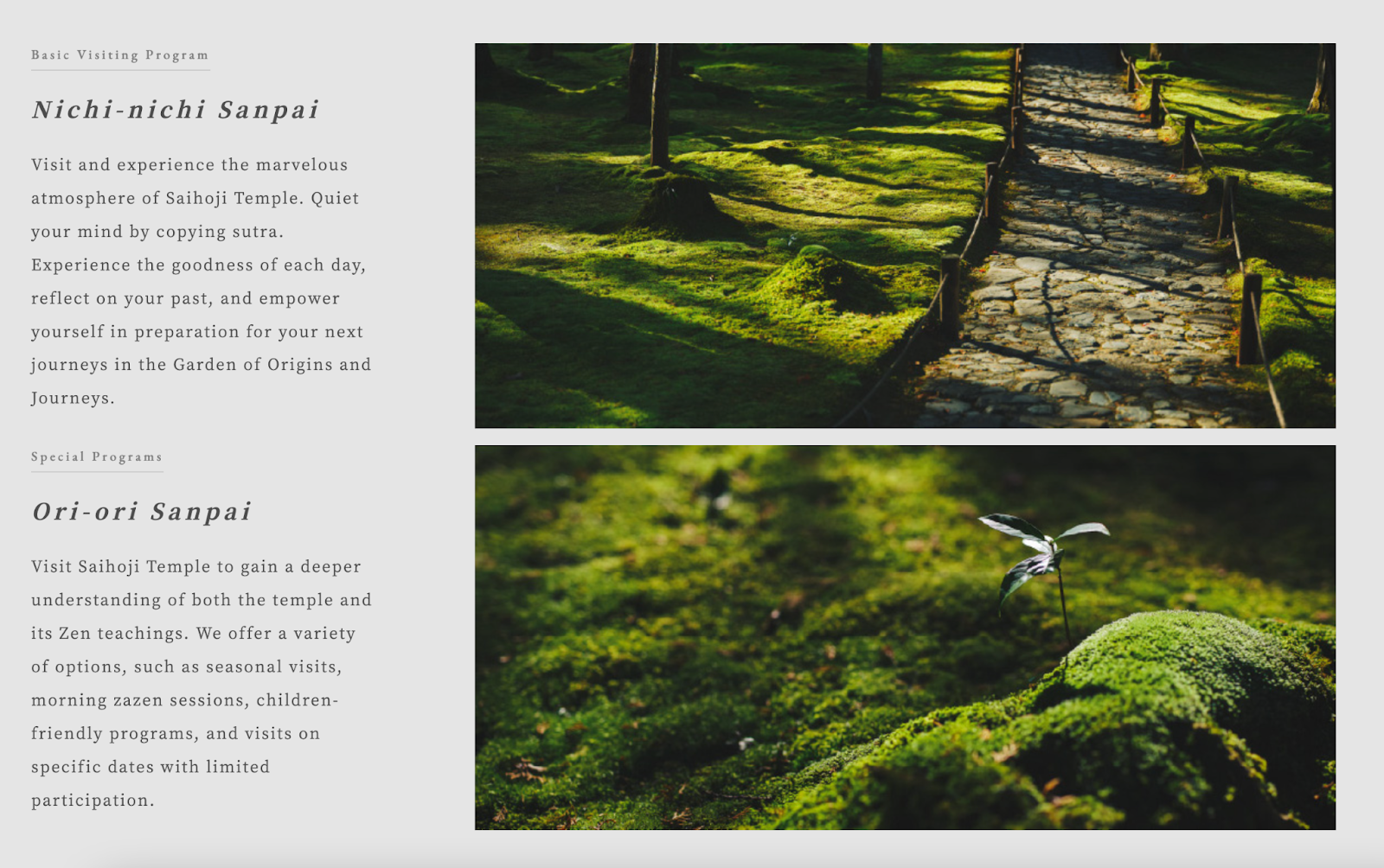
Here’s an overview of the 5 program types you can choose from when visiting Saihoji:
Tour Name | Visit Type | Highlights | Fee | Duration | Time |
Nichi-nichi Sanpai | sutra in the main hall, garden | 4,000 yen | 60 minutes | varies | |
Ori-ori Sanpai (members-only) | early morning access to the main hall & garden | 6,000 yen | 60 minutes | starts at 8:45 AM (dates vary) | |
Ori-ori Sanpai (members-only) | zazen practice in Prince Shotoku’s villa, visit to a traditional dry landscape garden | 8,000 – 10,000 yen | 60 minutes | starts at 8:45 AM (dates vary) |
Note, there is an additional 110 yen online booking fee per person. Additionally, the cancellation policy is:
- Free (up to 4 days prior to your reservation date)
- 50% of entrance fee (3 days before – 1 day before)
- 100% of entrance fee (same day)
3. Book a Visit
Once you pick the right tour for you, you can click Apply to This Program, which will take you to the reservation calendar. Note, you will need to be logged-in to access the reservation page.
Typically, reservations are made up to 2 months in advance, with availability coded by symbol.
- 〇 Available – means there are time slots available for that day
- △ Few Left – only a few time slots available remaining
- × Full – booked out with no more reservations available

The number of slots available is also categorized by color to show availability for members (black bar) versus non-members (white bar).

You can then proceed to finalize your booking.
Reservation Through Air-Mail or Return Postcard
In order to make a reservation by mail, you’ll need to send the temple a postcard with the following information:
- Desired date of visit
- Total number of visitors (up to 2 people per application)
- Group representative’s name (can be you!)
- Group representative’s address
All communication should be directed to the temple address at:
Saihoji Temple Office
56 Matsuo Jingatani-cho
Nishikyo-ku, Kyoto, 615-8286, Japan.
The application process by mail is much easier if you’re living in Japan or a country that uses an International Reply Coupon (IRC).
- If you’re already in Japan, you can head to the local post office or any convenience store to pick up a special return postcard known as an ofuku hagaki. The ofuku hagaki comes in a set of two, one of which the temple will use to confirm your reservation.
- If you’re in the US, your best bet is to ask your hotel or AirBnb host in Japan to help with you the booking as the USPS stopped selling IRCs in 2009. We were extremely grateful that our AirBnb host was gracious enough to help us with the whole process. Again, this is why I highly recommend using the new online reservation system.
How to Get to Saihoji (Kokedera) Temple from Kyoto
Seeing Kokedera is one of the best things to do in Arashiyama, especially after visiting the bamboo forest. From the Saga-Arashiyama Station, you’ll need to walk to the Suminokuracho bus stop. From there, you can take either Kyoto Bus 63 or Bus 73 which will take you to Saihoji in about ~10 minutes.
🎫 Cost: ¥230 (<$2)
⌛Time Spent: 15-20 minutes
📍Address: Saga-Arashiyama Station → Saihoji Temple l Take Bus 63 or 73
Note, the Kyoto Bus and local lines are not covered by the Japan Rail pass.
You can also walk to Saihoji in under an hour. This is perfect if you want to see more of Arashiyama, explore its residential areas, and get away from the crowds.

🚶♂️Walking Time: 55 minutes
📍Address: Saga-Arashiyama Station → Saihoji Temple l Stop for pictures at Togetsu-kyo Bridge
Best Times to Visit Saihoji (Kokedera) Temple
I may be biased because I first visited Kyoto in June but I found the summer to be perfect for visiting Kokedera. This time of year, especially between June to mid-July, is typically rainy season, which help keeps the moss lush and vibrant.
Late fall (mid-November to early December) is another great time to visit Kokedera when the green of the moss contrasts against the autumn leaves.
Winter is the worst time to visit Saihoji, as the garden is closed to the public for maintenance. During this time, you can still visit the main hall but it’d be a shame to come all the way to Saihoji and not see the moss garden.
Final Thoughts: Saihoji (Kokedera) Temple
As long as you’re not visiting Kyoto in winter, I know you’ll find the Saihoji simply amazing. And, it’s now easier than ever to visit Kokedera via the new online reservation system that no longer requires mailing a self-addressed postcard to secure an advanced reservation.
Thanks for reading & I hope this guide encourages you to see the moss garden for yourself! 😊